
Durable context
Memory and continuity
Three useful layers
| Layer | Scope | Store here |
|---|---|---|
| Thread history | One Chat, App, or schedule thread | The working conversation and its immediate artifacts |
| Self-memory | One Chat or App identity | Durable preferences and decisions specific to that thread |
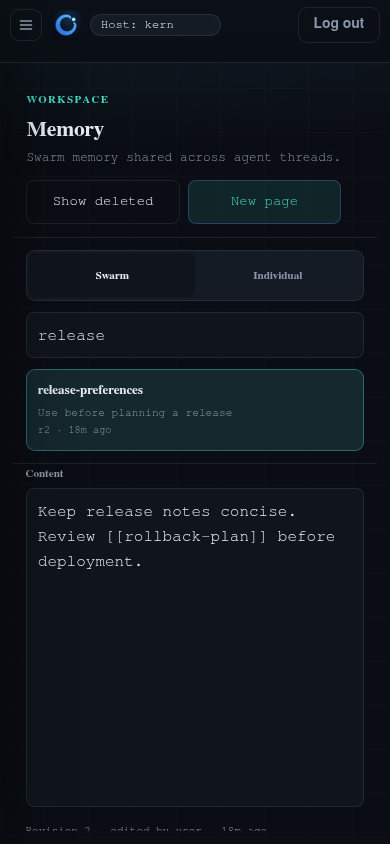
| Swarm memory | All threads on the host | Shared conventions, settled architecture, and reusable operating knowledge |
Complete history, improving retrieval
Kern retains the complete working history of Chat, App, and schedule threads on the host. Agents can search retained conversations when prior work matters instead of relying on a compressed prompt or asking the operator to repeat context.
Self-memory and swarm memory form a separate retrieval layer. Agents search the relevant memory before work, distill durable lessons back into it, and replace stale conclusions as understanding improves. The result is a retrieval system that gets more useful without treating every raw transcript line as permanent memory.
Keep memory tended
Memory decays the same way notes do. Conclusions go stale, pages drift toward transcripts, and the same lesson gets written three times in slightly different words. You do not have to police this by hand. Put it on a schedule and let the agent maintain its own memory on a cadence.
Every Sunday at 09:20 Europe/London, review memory.

Merge pages that cover the same thing, and replace conclusions that later work
proved wrong rather than appending corrections to them.
Make sure each description says when the page is worth reading.
Remove transient status and anything that reads like a transcript.
Tell me what you changed and what you deliberately left alone.